I had pinned so much on that appointment.
Aberdeen.
The long-awaited surgeon consultation.
The day I believed, genuinely believed, someone would finally hand me a path forward. Not an easy one but a possible one. A way to get my life back.
A plan. A solution. A “we can fix this.”
I didn’t go there expecting miracles. I just went there expecting hope.
The Build-Up
We arrived two hours early.
Two hours.
Because I could not, absolutely would not, risk anything getting in the way of this appointment. Not traffic, not weather, not bad luck. I live in the countryside, far from the big city and December has a mind of its own. If snow had fallen overnight or black ice had crept across the roads, that could have been it. Appointment missed. Answers delayed. Hope postponed again.
I wasn’t taking that chance.
This appointment had been looming over me for months, a place I’d been mentally stuck, suspended in a kind of medical limbo. My life had shrunk down to one single idea:
The surgeon will tell me what to do.
The surgeon will fix this.
The surgeon will give me a way forward.
I had researched everything I could get my hands on. YouTube lectures from American surgeons, the only people who seemed willing to discuss parastomal hernia repairs in any real depth. I learned about mesh types, repair techniques, recurrences, complications, stoma relocation. I picked up the lingo. I knew the risks. I knew the statistics. I knew the pros and cons of every method they described. But here’s what all those videos had in common:
Every single one of them ended with surgery.
Different techniques, different meshes, different placements but the conclusion was always the same:
“Here’s how we fix it in surgery.”
None of them spoke about what happens when surgery isn’t possible.
None of them said,
“Here’s what to do if you’re too high risk.”
None of them showed a path for someone like me, someone whose situation doesn’t fit the neat surgical narrative.
So I walked into that appointment believing surgery was the end point because that’s what every expert online had implied.
I never even considered that the cure might not be available to me.
The Moment Everything Tilted
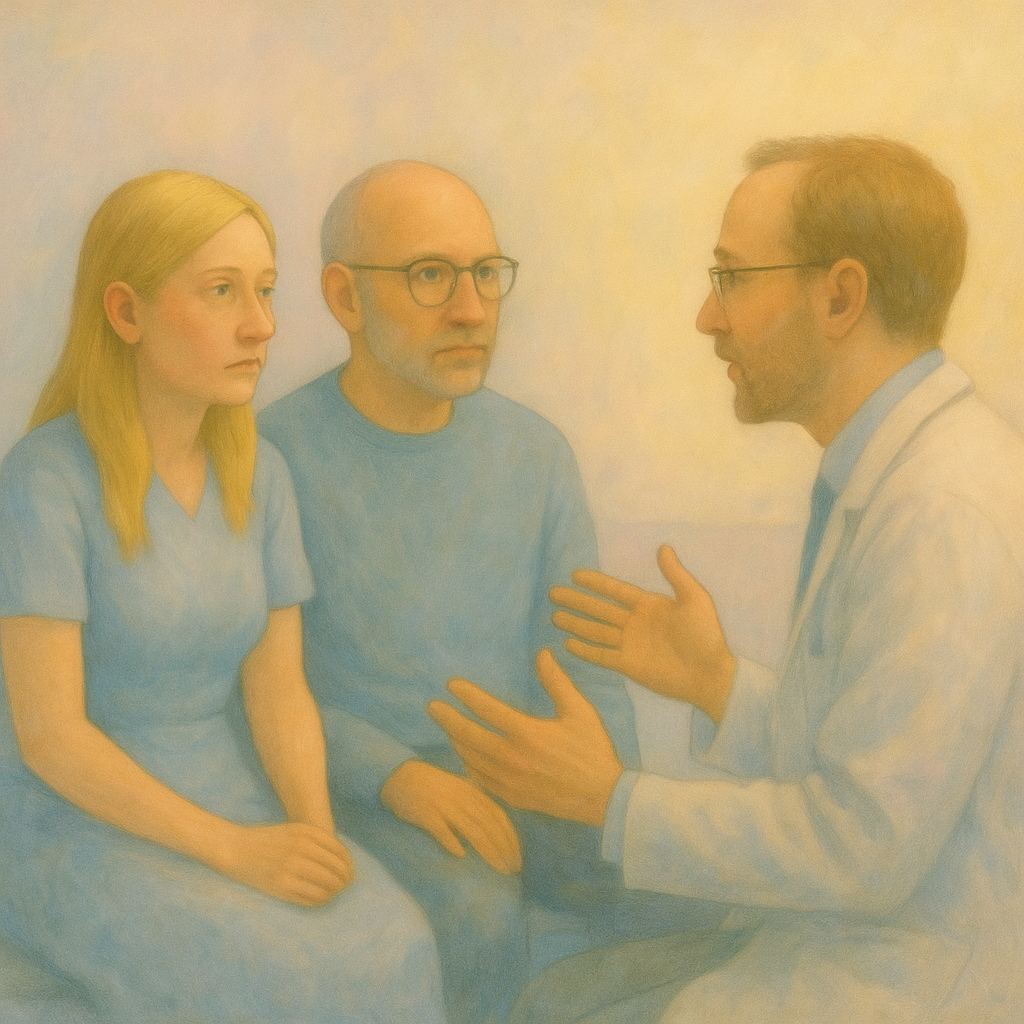
When we finally sat down face to face with the surgeon, he said,
“I want to figure out what’s happening.”
And I actually laughed.
Not a big laugh, just one of those short, breathy, are-you-kidding-me? laughs that slip out when you’re overwhelmed.
I said,
“I’d love to know too!”
What he didn’t know, what he absolutely couldn’t have known, was that the last surgeon I’d seen had literally brushed me off when I asked for more detail about the parastomal hernia.
He told me I didn’t need to know and sent me away.
So when THIS surgeon said he wanted to understand what was going on, as if it were a mystery for both of us. I felt this strange mix of relief and disbelief.
And then he said something I will never forget.
“I know you had your large colon removed — a total colectomy in 2003.
And looking at your CT scan, I can see all of your small intestine is stuck in your pelvis.
But I can’t tell whether your rectum is buried inside that intestinal mass…
or whether it’s actually been removed ?”
I just stared at him.
Wow, I thought.
Just… wow.
Here I was, sitting in front of a surgeon who couldn’t even tell if a whole organ was still inside me or not, because my small intestine was so tangled, so adhered, so glued into my pelvis that it was hiding everything beneath it.
So I told him.
I confirmed that eighteen years ago, my rectum was removed because it was showing early signs of becoming cancerous and because the ulcerative colitis was still so aggressive and active.
He nodded, slowly, taking it in.
And that’s when I saw it — the moment it clicked for him that my anatomy is not just unusual… it’s complicated in ways that make surgery dangerous.
And in that instant, I understood something too:
He wasn’t withholding hope.
He was trying to protect my life.
The Reality I Wasn’t Prepared For
Then came what I wasn’t expecting at all.
He told me my small intestine is stuck. Stuck deep down in my pelvis. He explained that if he attempted surgery, he wouldn’t know how bad the adhesions were until he was inside.
He didn’t know if he could even free enough bowel to form a new ileostomy. He didn’t know if there was enough length to work with at all.
And then he said the part that hit the hardest:
There is a real risk he could perforate my bowel while trying to separate the adhesions.
Every word felt like another door closing.
And all I could think was:
How did my body go from completely fine to this in only nine months?
I hadn’t needed help for over a decade. No problems, no warnings, no reason to think anything was wrong. Then one accident and suddenly my insides weren’t where they should be anymore. It was like my body had changed without giving me time to catch up.
The Questions I Never Got to Ask
I went into that appointment with a head full of questions, the kind you prepare when you truly believe surgery is coming.
I wanted to ask:
“Will you flush out all the debris and blood after surgery?”
“Will you use a barrier to limit new adhesions?”
“What kind of mesh do you use?”
“Will you gently place my small intestine back inside my abdomen, laying it out in soft, flowing loops?”
I wanted the technical details because knowledge makes me feel less afraid. I wanted to leave that room with answers, specific ones, so I could plan, prepare and rebuild myself from the ground up.
But I never got to ask a single one of those questions.
The Truth I Had to Reveal
In all the research I had done, hours of American surgeons lecturing online, one message kept repeating:
“If you know anything about your previous surgeries, you must tell your surgeon.”
So I told him.
I told him something I had been carrying for eighteen years, information that had never made it into my medical notes.
After my last major surgery, my previous surgeon had moaned — literally moaned — about how many adhesions I had.
How difficult it had been. How my small intestine had been stuck to my womb.
And here’s the unbelievable part:
There was no record of that anywhere.
Not in my file.
Not in my notes.
There wasn’t even documentation that I’d had my rectum removed, let alone anything explaining the adhesions that shaped my anatomy.
I had to breathe deeply before telling him, because once those words left my mouth, there was no taking them back.
But he needed to know.
It was vital information.
Information that should have been written down, passed forward, used to protect me.
Instead, I was the only one who held it and saying it aloud sealed my fate in that room.
The Hope I Had Carried In
What broke me wasn’t a firm “no.”
He never actually said that.
What he said was somehow worse, softer, slower, laden with meaning I wasn’t ready for.
He said I was high risk.
Very high risk.
He said,
“I’m not saying I won’t do the surgery… but I need you to really listen to me.”
And I was listening.
Deeply.
But I was also overwhelmed, too overwhelmed to speak, too flooded to respond.
He told me to go away and think about everything he’d explained because he wasn’t sure I was taking it in.
Not because I wasn’t listening but because the information was so huge, so life-defining, that no one could possibly absorb it in the moment.
He said:
“I’m not refusing surgery. I just don’t know what it looks like in there. I need to take your case to a multidisciplinary team meeting. We’ll discuss it together, and I’ll get back to you in the new year.”
So it wasn’t a closed door. But it also wasn’t the open doorway I had imagined.
It was something in between — a place of uncertainty, a place where risk shadows every option, a place where even the surgeon hesitates because the danger is so real.
And sitting in that space, the space between “maybe” and “high risk”, was its own kind of devastation.
What I Had Hoped For
I had imagined mesh repairs, the kind of surgery people talk about in quiet, relieved voices. The possibility of being built back up, stronger than before but this time armed with the knowledge I never had all those years ago.
I imagined healing with understanding. I imagined knowing what to avoid, what to strengthen, what to protect. I imagined having a second chance with my body, not the naïve girl I once was but someone wiser, more careful, more in tune.
I had held onto the hope that I might mend. That I might rebuild.
That I might not be dependent on raised toilet seats, handrails beside my bed and the stack of Occupational Therapy equipment that has slowly crept into my life and my identity.
I thought this appointment might be the doorway back to independence.
To the simple dignity of moving without fear.
Instead… it was the doorway to a truth I wasn’t ready to meet.
The Corridor Collapse
I held myself together for as long as I could. Held the tears back, the panic back, the disbelief back. Held on to the last thread of the future I’d imagined.
But the moment we stepped out into the corridor — that long blue floor with the orange stripe on the wall, so you always know where you are — something in me broke.
Not a crack.
A collapse.
I stood there, in that busy hospital corridor, people walking past, lives moving, footsteps echoing and I felt everything drain out of me at once:
Hope.
Strength.
Plans.
Belief.
Fight.
Gone.
My husband was beside me but even with him holding me up, I felt like I was falling through myself.
Deflated.
Lost.
Helpless.
Like someone had opened a door to a future I didn’t choose and pushed me into it without warning.
The realisation hit hard:
This is it.
This is the body I have.
This is the hernia I live with.
This is the risk hanging over me now, one wrong move, one wrong twist, one wrong lift… and I’m in emergency, high-risk surgery territory.
It felt like my soul dimmed in that corridor.
Like the life I had been fighting so hard to return to had quietly slipped out of reach.
Everyone else walked past as if nothing had happened.
But inside me, everything had changed.
And that is the moment I think my grieving truly began, not grieving what I lost but grieving the life I thought I could still get back.
This post reflects personal experience and reflection, not medical or professional advice.