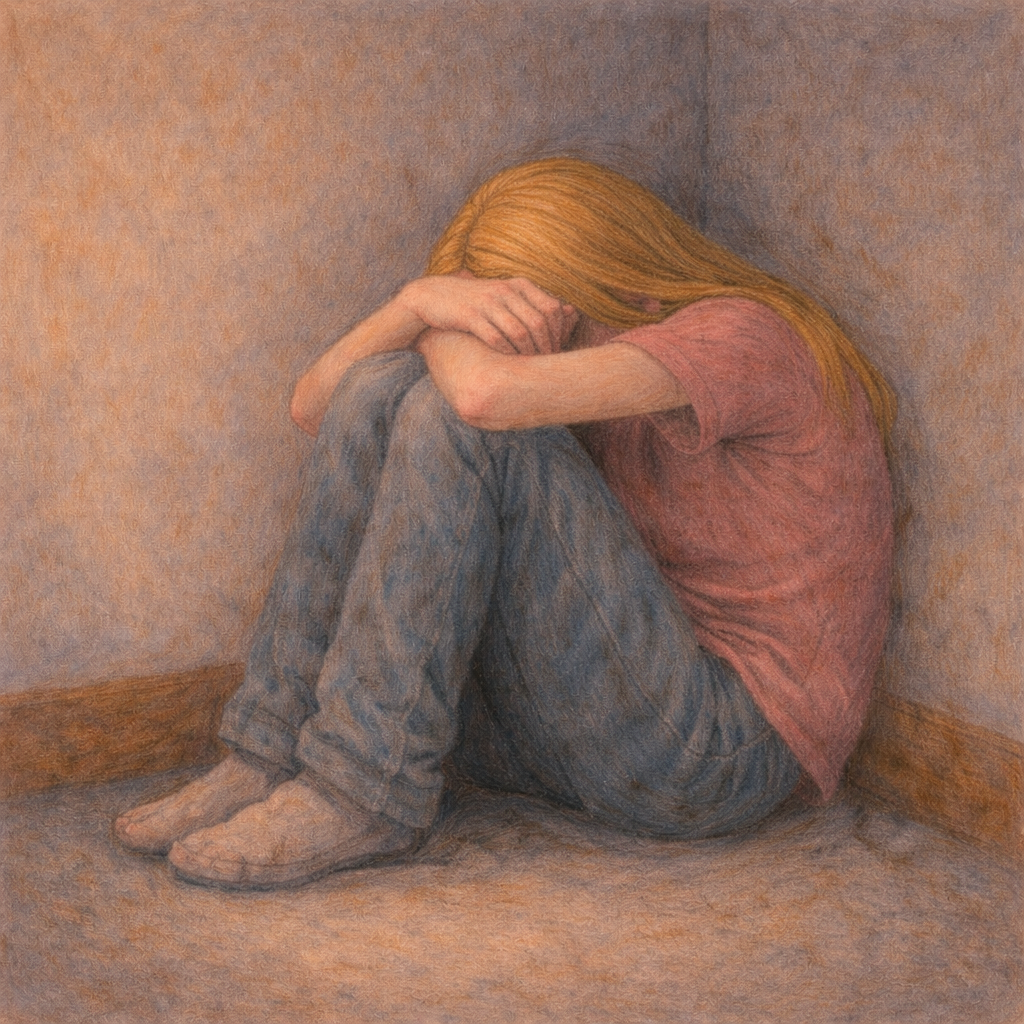
This piece reflects on early life experiences, trauma, chronic illness and suicidality.
There’s no single, tidy explanation for why someone develops ulcerative colitis.
Medicine talks about genetics, immune dysfunction, environmental triggers.
Those things may all play a role. But when I look honestly at my own life, I cannot separate my illness from the conditions I was forced to live under.
Stress wasn’t a background factor for me. It was the environment and it started long before my body finally broke.
Growing up without safety
I did not grow up in a body that knew rest.
I grew up in constant vigilance, emotional instability, unpredictability, fear.
I learned early to stay alert, to manage other people’s emotions, to minimise my needs, to endure.
My nervous system never stood down.
There was also neglect.
Periods of being underfed.
Malnutrition that wasn’t occasional, but ongoing enough to matter. A growing body without consistent nourishment, without security, without care.
That kind of stress doesn’t pass through you.
It embeds itself.
A body pushed past its limit
By the time ulcerative colitis appeared, my body had already spent years in survival mode.
Chronic stress.
Fear.
Hypervigilance.
Malnutrition.
Emotional abandonment.
Emotional and physical abuse.
Adult responsibility placed on a child.
Foster care.
My immune system didn’t suddenly malfunction for no reason. It had been living inside a body that never felt secure, never felt fed properly, never felt allowed to rest.
When my gut became the site of collapse, it felt brutal but it didn’t feel random. It felt like the place where everything I couldn’t express finally surfaced.
The gut remembers what the mind survives
We now understand far more about the gut–brain connection than we once did.
Stress alters digestion.
Fear alters gut motility.
Chronic threat alters immune response.
A nervous system that never gets relief doesn’t reset, it adapts and sometimes that adaptation becomes inflammation, autoimmunity, breakdown.
My body learned to live under pressure long before I had words for it. Ulcerative colitis was not the beginning of that story.
It was the point where my body could no longer compensate.
This is about cause, not coincidence
I don’t believe what happened to me was a coincidence. I believe multiple factors converged:
Long-term psychological stress.
Fear and lack of safety.
Malnutrition.
Emotional neglect.
Acute trauma layered on top of chronic instability
Together, they created a body that was already overwhelmed.
Ulcerative colitis wasn’t just an illness that arrived one day. It was the consequence of years of conditions no child should have to endure.
Why I name this now
I name this because it matters.
Because understanding where my illness came from has changed how I treat myself.
It’s why I don’t believe in pushing through.
Why gentleness isn’t indulgence, it’s corrective. Why safety, predictability, nourishment and rest are not optional extras in my life now.
They are the things my body was denied. Ulcerative colitis changed my life. But it didn’t come out of nowhere.
It came from a body that carried too much, for too long, without protection and telling that truth is part of reclaiming myself.
The repeated pattern of what terror feels like
In the months leading up to my ulcerative colitis, something happened that my body never forgot.
On my sixteenth birthday, my mother tried to jump off a bridge.
I was there.
I had to physically struggle with her to stop her. I had to pull her back, hold her and then get her into a telephone box so I could phone the police for help – trying to keep her safe while my own body was shaking with fear.
That was the moment my nervous system crossed a line it never uncrossed.
It wasn’t just fear, it was responsibility far beyond my years. The kind that rewires you. The kind that teaches a child, instantly, that there is no safety net.
Shortly after that, she was admitted to a psychiatric hospital for three months.
And I was left alone.
This wasn’t an isolated incident.
Suicide attempts were a regular part of my home life – something that happened again and again, until crisis felt ordinary and danger became background noise.
The months before everything collapsed
After that night, my life narrowed into survival.
I was living alone in a bottom-floor flat in what was known locally as the roughest part of town. We had only moved there four months earlier. There were no curtains at the windows.
I was scared, properly scared, to be in the house on my own.
At the same time, I was waiting on exam results that would determine my future. I worked a weekend job. And every day, I walked over two miles to visit my mother in hospital.
Alone.
Carrying fear, responsibility and grief that had nowhere to go.
There was no adult stepping in to protect me. No one checking if I was coping. No one ensuring I was eating properly, sleeping safely or feeling held.
My body learned then that the world was dangerous and that it was on its own.
Nowhere to land
Around the same time, I had just started a new school. I didn’t know anyone. I had no friends yet and I was bullied.
There was no soft place in my life, not at home, not at school, not even in my own body. Every environment asked me to stay alert, to brace, to endure.
At school, I learned quickly how to make myself smaller. How to stay quiet. How to disappear enough not to draw attention.
At home, I learned how to stay awake to danger. How to listen for sounds. How to cope alone. So my body never rested.
It couldn’t.
There was no “safe enough” space where I could come down from the constant readiness. No one noticing, that a sixteen-year-old shouldn’t be carrying this much fear, responsibility and isolation all at once.
When I look back now, it’s clear:
My nervous system was never given a chance to regulate.
Many factors, one body
People often want a single cause for illness. A neat explanation but bodies don’t work like that.
What I lived through wasn’t one stress – it was layer upon layer:
Acute trauma.
Prolonged fear.
Isolation.
Malnutrition.
Responsibility beyond my years.
Bullying.
Instability.
Lack of safety.
Emotional and physical abuse.
Each one alone might have been survivable.
Together, they created a body that was doing everything it could just to stay upright.
So when my gut finally broke down, I don’t see it as weakness. I see it as a system that had been pushed beyond its capacity and finally spoke up.
This post reflects personal experience and reflection, not medical or professional advice.